LuckyPays Licence and Trust: UKGC Status, Regulation and Player Protection
 Available in GB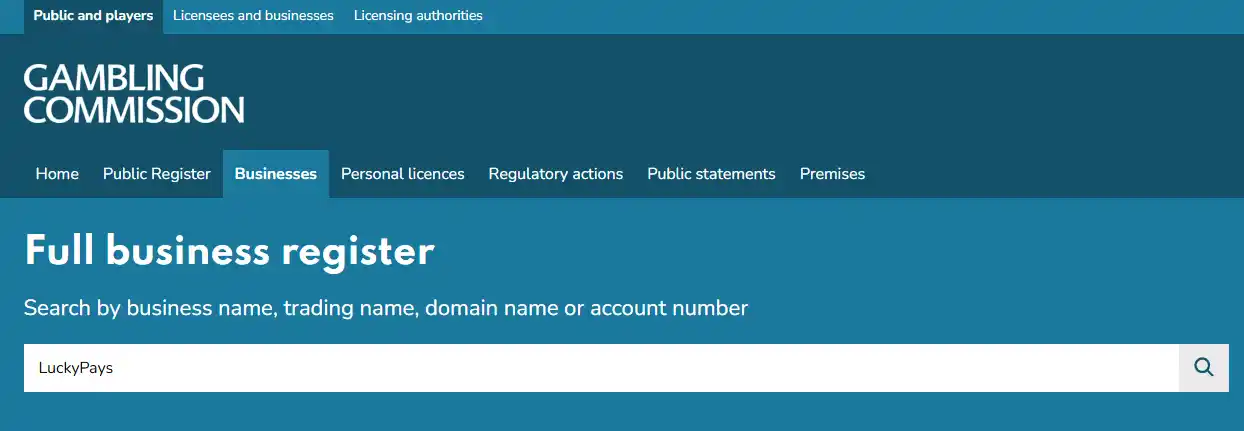
The UKGC public register dated 26 September 2026 does not identify a licence entry under the LuckyPays brand or its stated domain. Remote operators serving consumers in England, Scotland and Wales require the relevant Gambling Commission licence. Without an identifiable entry for LuckyPays, local regulatory protections and UKGC-supervised complaint routes should not be assumed to apply to the casino.
Public operator material links LuckyPays to an Anjouan-licensed company, but the LuckyPays domain does not appear in the domain information associated with that company’s current licence record. Other public listings name a different company. A corporate licence, its coverage of a specific website and the identity of the party contracting with a player are separate questions; an answer about one does not settle the others.
LuckyPays and the Great Britain business register
The Gambling Commission business register, dated 26 September 2026, does not identify a LuckyPays licence entry under the brand or stated domain. The register can be searched by trading name, legal business name or domain. When a casino cites an operator name, its listed domain and the contracting company should be compared with the business record, not just with a similar name.
The regulator explains that a business providing remote gambling to consumers in Great Britain needs a Gambling Commission licence, regardless of where the business is based. Great Britain in this context means England, Scotland and Wales. Northern Ireland is not silently included in that licensing statement.
The Gambling Commission Gambling Commission business register lists operating licensees and their recorded information. Compare the exact website domain, trading name and legal business rather than relying on a badge or a generic statement that a casino is licensed.
How a UKGC licence relates to a casino domain
A reliable check separates three fields that are often blurred together: the legal operator, the licence jurisdiction and the domain covered by the licence. A licence held by one company does not automatically cover every site that has ever been associated with that company, and a domain’s marketing text does not replace the regulator’s current register.
- Search the regulator. For Great Britain, search the Gambling Commission by business name, trading name and domain.
- Match the entity. Confirm that the legal name in the register matches the entity named in current terms or footer text.
- Match the domain. Check whether the exact gambling domain is recorded against the licensed business.
- Check status. Active, suspended, surrendered and revoked are materially different results.
- Record the date. A licence check is time-sensitive because register data and domain portfolios change.
An English-language page, a GBP reference or access from Great Britain is not itself a UKGC licence. The operator and website domain must connect to the Gambling Commission’s register for the relevant local authorisation to apply.
What the Gambling Commission requires for remote gambling
The Commission’s current remote-sector guidance says that a business needs a licence if it provides facilities for remote gambling to consumers in Great Britain. The rule applies even when the operator is based abroad. The regulator’s remote casino licence page gives the same territorial rule for casino games delivered through websites, mobile phones or other online services.
Great Britain’s regulatory framework requires the appropriate licence for remote gambling offered to its consumers. It does not follow that every overseas website presents the same access or registration options in every part of the United Kingdom. The absence of an identifiable LuckyPays record in the UKGC register is a specific licensing issue, distinct from technical accessibility.
The Gambling Commission remote-sector guidance explains the licensing trigger, while the remote casino operating licence page describes the licence used for online casino games.
Anjouan licence and LuckyPays domain coverage
LuckyPays terms associate the service with Igloo Ventures SRL and an Anjouan licence. Regulator-linked domain information lists an active licence for that company but does not include luckypays.io among its current covered domains. Another public listing names a different Costa Rican company. These differences matter because a licence held by a company does not automatically establish that a particular website is included in its registered domain portfolio.
The distinction is between a company’s licensing status and the domains covered by its licence. The operator’s terms should identify the contracting company and the actual website, while the regulator record should connect the domain to the licence. If those details do not align, a number printed in a footer alone does not settle domain coverage.
The distinction also prevents a common error: a valid licence held by a company can be real while a particular domain’s current coverage remains unverified. Both statements can be true at once. The useful question for a player is not simply “does this licence number exist?” but “does the current regulator record connect this operator and this exact domain?”
Operator identity is a separate unresolved field
LuckyPays materials associate the brand with Igloo Ventures SRL, while a public review-profile listing names a different Costa Rican entity. The current contracting party for a given website and account should be identified from the terms displayed at the point of registration. A licence holder may not be identical to the party named in a separate review-platform profile.
That restraint matters for practical reasons. The company named in terms can be the entity responsible for the service relationship, while a licence holder may be a different legal entity. If a payment, complaint or contractual dispute arises, those names determine where a user directs questions and which regulatory route is relevant.
Before creating or funding an account, compare the legal name in the current terms, footer and cashier with the name in any regulator record you are relying on. If those names do not align, treat the mismatch as something to resolve before assuming a particular protection scheme applies.
GAMSTOP: what it covers and what it does not prove here
GAMSTOP is the national online self-exclusion scheme connected to Great Britain-licensed remote gambling. GAMSTOP’s current guidance says all online gambling companies licensed in Great Britain must participate, and its operator portal is for remote gambling companies licensed by the Gambling Commission.
GAMSTOP applies to participating remote operators licensed by the Gambling Commission for Great Britain. In the absence of an identifiable UKGC licence entry for LuckyPays, do not assume that opening a LuckyPays account would fall within the scheme’s protection. Technical access to a website and membership in a self-exclusion scheme are separate matters.
Readers who use GAMSTOP should rely on the scheme’s own scope. The GAMSTOP overview explains that registration blocks access to gambling websites and apps licensed in Great Britain. The GAMSTOP coverage guidance states that all online gambling companies licensed in Great Britain must be part of the service.
What UKGC licensing normally gives a Great Britain player
A UKGC licence is not merely a badge. It places the licensed operator inside a framework of licence conditions, technical standards, age and identity checks, responsible-gambling requirements, complaint procedures and regulatory enforcement. It also makes the operator searchable in the public register, where licence status and declared domains can be checked.
The Commission requires its licensees to perform identity checks, apply promotional conditions and observe online-slot stake limits. Those are Great Britain regulatory requirements for covered operators, not an automatic description of LuckyPays’ own account and game settings.
A UKGC requirement applies within that regulatory framework, not automatically to an overseas casino. For account use, payment conditions and promotions, see registration and KYC, bonus terms and payment methods. Local authorisation remains a separate issue.
Trust is broader than a licence field, but the fields should not be mixed
Licensing tells a customer which regulator and consumer safeguards govern a gambling service. LuckyPays’ game catalogue, live dealer section, mobile-browser access and payment options describe the offering, but cannot show whether the exact domain is covered by a Great Britain licence.
The reverse is also true. A working game library, familiar payment card logos or a responsive mobile site do not establish regulatory protection. Product availability and licensing answer different questions and should stay separate.
A familiar game studio or payment-logo display is not a substitute for regulator information. Conversely, a licensing question does not by itself explain whether a specific table, payment method or account feature is available. The two questions should be considered separately before sending funds.
Payments and withdrawals: what licensing changes in the decision process
Before depositing, identify the contracting company named in the terms, the account currency, applicable withdrawal conditions and available complaint routes. The payment methods section covers deposit routes, while withdrawals covers cash-out stages, identity checks and limits shown for the account.
A UKGC-licensed operator sits within a known regulatory and complaint framework. Without an identifiable LuckyPays entry under its brand or stated domain, do not assume access to UKGC-regulated alternative dispute resolution, UK-specific consumer-funds protections or other licence-dependent remedies.
That does not require speculating about a future dispute. It simply changes what can responsibly be promised before a deposit is made.
Complaints and licensing address different questions
Player complaints are not licence records. They can reveal recurring themes such as verification friction, payment delays or support problems, but they are user reports and should be analysed separately from regulator data. The planned complaints and reputation handles those themes without turning individual reviews into proven facts.
A mismatch in domain coverage does not explain every customer’s experience. A complaint should be assessed against its transaction status, operator response and applicable terms; licensing information addresses which regulatory framework governs the operator and domain.
A practical trust-check sequence for Great Britain readers
- Search the Gambling Commission register. Match the exact domain and legal business, not just a similar trading name.
- Read the current terms. Identify the contracting entity and governing terms before funding an account.
- Match any overseas licence at domain level. A licence number alone is insufficient if the current regulator record does not connect the domain.
- Check self-exclusion coverage. If GAMSTOP protection matters to you, use the scheme’s own participating-company information and UKGC register.
- Review payment and withdrawal terms. Use the current cashier information for account-specific conditions.
- Keep evidence. Save relevant terms and transaction records if you choose to proceed with any gambling service.
This sequence does not tell a reader what decision to make. It identifies which facts determine the regulatory and practical protection available.
The exact domain matters because brands can use more than one address and a company can hold a licence covering only specified services or websites. The legal entity in the account terms, the trading name on a regulator record and the payment recipient may also need comparison. Do not treat a similarly named company or another domain in the same business group as proof that the site in front of you has the same regulatory protection.
Why licence and domain records can change
The Gambling Commission updates its register, and operator domains can be added or removed. Likewise, overseas licences may cover a changing list of websites. When assessing a gambling service, look at the latest available record for the exact domain rather than relying on a company name, a licence badge or a record for another website.
A change to the UKGC business entry or the Anjouan domain listing could alter which safeguards apply. The operator’s terms should also identify the party providing the service. Those licensing and contracting details are separate from the game types, payment routes and mobile access visible in the product.
LuckyPays licensing in context
The UKGC register dated 26 September 2026 does not identify LuckyPays by the brand or stated domain. Public materials connect Igloo Ventures SRL to an Anjouan licence, but the LuckyPays domain is absent from the associated current domain information, and public company-name listings differ. A company licence should not be treated as proof of coverage for a domain that is not identified in the record.
Casino features and licensing answer separate questions. For games, banking, mobile use and promotions, return to the LuckyPays review. For safeguards, compare the regulator information and contracting terms tied to the exact website domain.